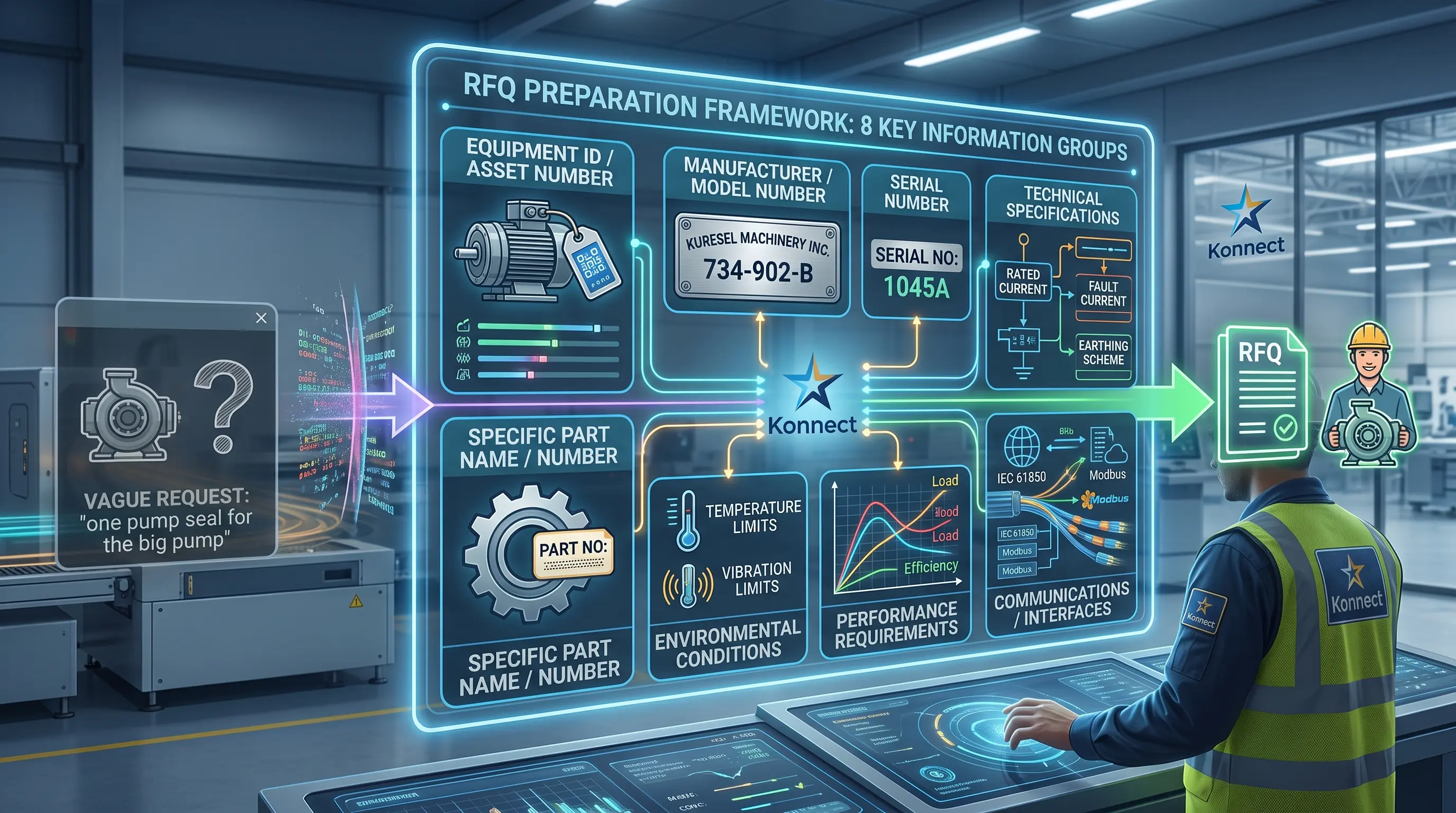
A request for quotation (RFQ) is only as good as the information behind it. When a maintenance team sends an RFQ with vague wording like "one pump seal for the big pump," the buyer, the supplier, and ultimately the plant all lose. The supplier has to guess, the quote comes back wrong, and the order arrives late — or worse, with the wrong part.
The fix is simple: gather the right technical and commercial information before you press send. This article walks through the eight groups of information your maintenance team should collect and share whenever an RFQ goes out.
A well-prepared RFQ does three things:
- Eliminates guesswork — suppliers quote on facts, not assumptions.
- Shortens lead time — no back-and-forth clarification emails.
- Protects against rework — fewer wrong parts, fewer returns, less downtime.
Every missing field adds cost downstream. The table below shows what commonly goes wrong when key details are left out.
| Missing information |
Typical consequence |
| Part number |
Supplier cross-references to the wrong item |
| Operating conditions |
Material chosen fails under heat/corrosion |
| Tolerance/spec |
Part made to wrong dimensions |
| Quantity & timeline |
Wrong pricing tiers, delayed delivery |
| Certifications |
Part rejected during inspection |
| Maintenance history |
Root cause repeats after replacement |
1. Machine and equipment identification
Never describe a part in isolation. Give context about the equipment it belongs to:
- Machine type, make, and model
- Serial number of the machine or unit
- The specific system or line the equipment serves
This helps the supplier confirm they are quoting for the correct application, especially on older or heavily modified installations.
2. Exact part identification
This is the heart of the RFQ. Include as many of these as possible:
- Original part number (the one stamped on the component)
- Manufacturer / brand of the original part
- Description — what the part does and where it sits in the assembly
- Any cross-reference numbers or superseded (updated) part numbers
Read more about turning a part number into an exact match in How to Find the Right Spare Part Using a Part Number.
3. Full technical specifications
Do not rely on names alone. Share the physical and performance data that defines the part:
- Materials (e.g., stainless steel, hardened alloy)
- Dimensions, weight, and tolerances
- Operating ratings (pressure, temperature, speed, voltage)
- Finish or coating requirements
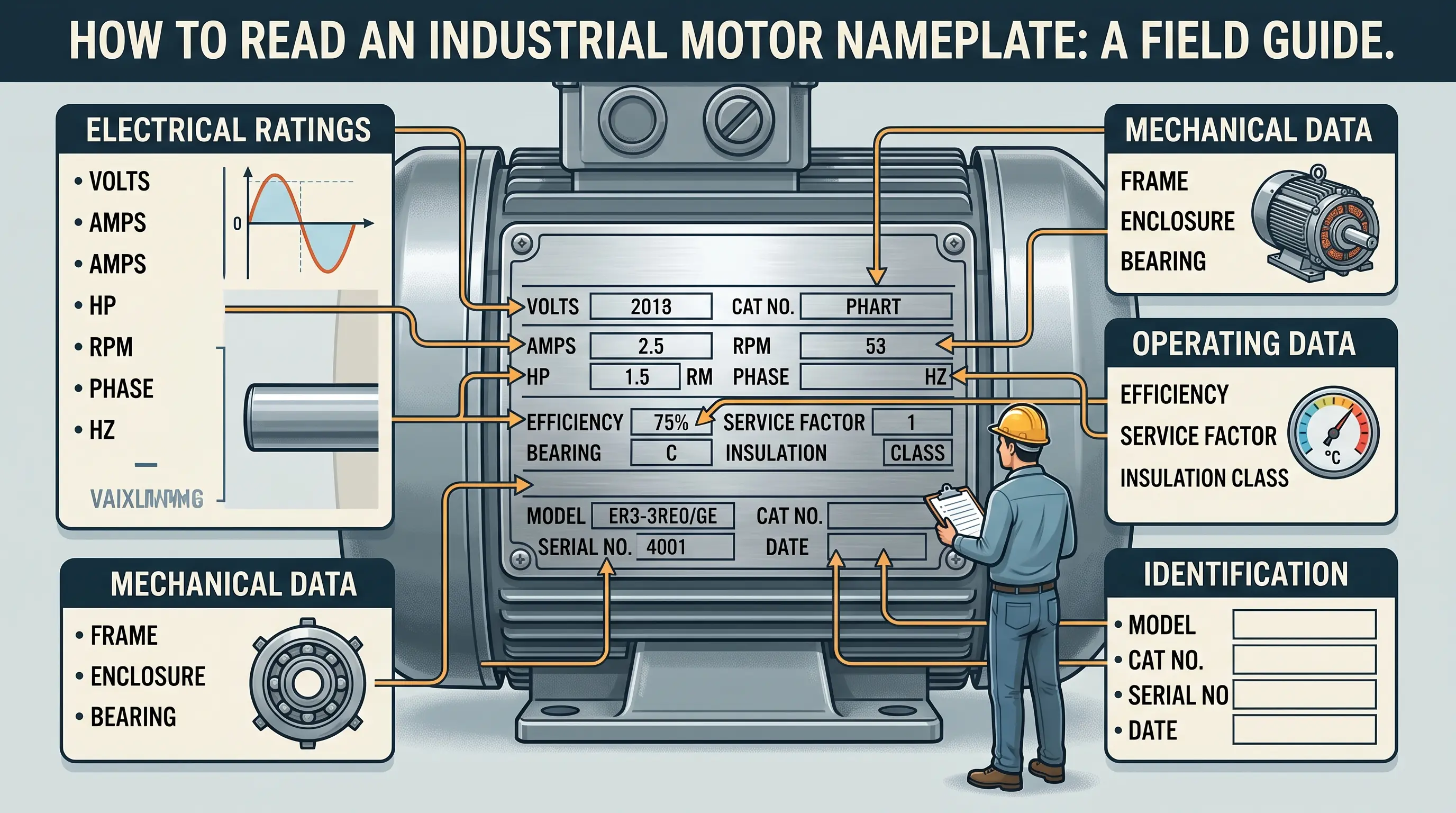
- If the part carries a nameplate, photograph or copy every value on it. Our guide to reading an industrial motor nameplate walks through the key fields.
4. Working & environmental conditions
Parts are chosen as much for where they run as for what they do. Specify:
- Ambient temperature range
- Exposure to moisture, dust, chemicals, or washdown
- Duty cycle and loading
- Any explosion-protected or hygienic requirements
5. Quantity, timeline & delivery
Commercial clarity prevents pricing surprises:
- Quantity needed (and whether it's a one-off or repeat)
- Target delivery date
- Delivery location and terms
- Any minimum order or preferred packaging
6. Certifications & documentation
If compliance matters, say so up front:
- Certificates needed (material, test, conformity)
- Standards the part must meet
- Test reports or traceability requirements
- Any ATEX, IECEx, or other risk-zone marking
7. Maintenance history & failure context
A supplier can quote a better solution when it understands the problem:
- Why the part is being replaced (wear, sudden failure, upgrade)
- How often it fails
- Photos of the old part and the installation
- Previous repair or replacement history
Close the loop:
- Named engineer or buyer responsible for the RFQ
- Site contact for inspections
- Preferred quote format (by part number, by line item, total)
Building the RFQ checklist
Use this as a starting skeleton for your own RFQ template:
Machine / equipment:
  - Type, model, serial
Part identification:
  - Part number, brand, description
Specifications:
  - Material, dimensions, tolerances
  - Operating conditions
Commercial:
  - Quantity, delivery date, location
Compliance:
  - Certificates, standards, documentation
Context:
  - Failure mode, maintenance history
Contact:
  - Owner, site, preferred format
Common mistakes to avoid
- Too little detail — "one motor" is not an RFQ; give the nameplate data.
- Too much ambiguity — avoid words like "or equivalent" unless a clear reference exists.
- Skipping photos — a photo of the old part or nameplate resolves most doubts instantly.
- No deadline — without a response-by date, quotes slip.
Choosing the right part type
Once the technical data is complete, decide what you are buying — original equipment, surplus, refurbished, or used. Each option has different lead time, cost, and warranty implications. Our guide to OEM vs. aftermarket vs. refurbished vs. used parts breaks down the trade-offs.
And if the part is no longer in production, follow the obsolete and discontinued parts sourcing checklist to avoid dead-end sourcing.
The takeaway
The RFQ is a two-way communication document, not a purchase order. When a maintenance team shares complete machine data, part identification, operating conditions, commercial terms, compliance needs, and history, suppliers can quote accurately the first time. That accuracy directly translates into shorter lead times, fewer returns, and less downtime — which is exactly what every maintenance team is trying to protect.